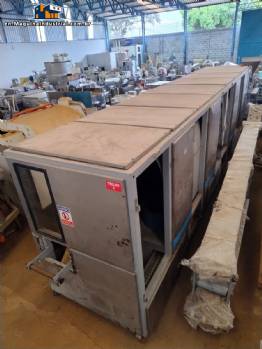
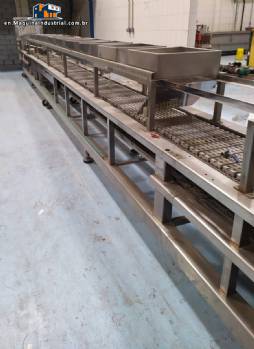
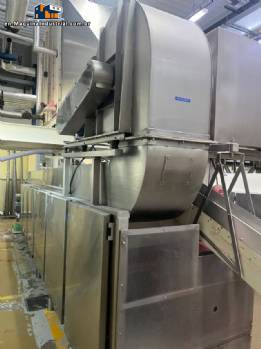
Cooling tunnels for candies and lollipops are industrial equipment used to reduce and control the temperature of products after cooking, deposition, molding, shaping, or extrusion stages. They are typically installed continuously in production lines, receiving the candies or lollipops while still hot and conveying them through a cooling chamber until they reach the appropriate temperature, consistency, and stability for subsequent stages of the process, mainly finishing and packaging.
Cooling serves to remove heat from the product in a controlled manner, stabilize its structure, preserve its shape, and reduce problems such as deformation, adhesion, and stickiness. In hard candies, for example, the product may exit the molding or deposition machine while still hot and needs to be cooled before packaging. In lollipops, cooling is also fundamental to maintaining the shape, especially in spherical models, preventing deformation during transport along the line. Manufacturers of industrial equipment use specific tunnels for both hard and soft candies, as well as for flat and spherical lollipops.
These tunnels can be used in the manufacture of various types of products, such as hard candies, soft candies, chewy candies, filled candies, deposited candies, molded candies, gelatin candies, gummy candies, gummies, jellies, caramels, toffees, pastilles, drops, chewing gum, and flat, round, spherical, or filled lollipops. Flexible industrial lines exist that can work with different candy and lollipop shapes using the same cooling system.
In molded hard candies, the sugar mass is typically prepared, shaped, and divided into the desired units before entering the tunnel. Cooling rapidly reduces the temperature and hardens the product, allowing the candies to maintain their geometry and be sent directly to packaging systems. In industrial lines, air can be directed over the products by fans to provide uniform heat exchange.
In deposited hard candies, the still-fluid mass is dosed directly into the mold cavities. The molds themselves then move into the cooling tunnel and remain in the system until the candies are sufficiently hardened to be demolded. This process is used industrially in the continuous manufacture of deposited candies and can also be employed for lollipops.
For gelatin candies, gummy candies, and gummies, the tunnel can receive the molds containing the newly deposited product. During the journey, the temperature is reduced and the mass stabilizes or gels until the units acquire sufficient consistency to be demolded. Depending on the formulation, there may be an additional conditioning or drying step afterward.
For caramels, toffees, and chewy candies, cooling allows the mass temperature to be reduced and the necessary consistency to be achieved for subsequent steps, such as cutting, separation, or packaging. Specific industrial tunnels are also used to cool strands of chewy candies and gums before cutting and packaging systems.
In the case of lollipops, equipment may have specific characteristics depending on the product's shape. Flat lollipops can be transported on conveyor belts, while round or spherical lollipops can use specially developed systems to move and cool the product without causing deformation. There are also universal tunnels capable of working with hard candies, flat lollipops, and spherical lollipops in the same equipment.
Regarding construction, tunnels can be linear, in which the product travels through the equipment in a single direction; multi-passage, which increases the residence time inside the cooling chamber; or multi-level, with several conveyor belts or overlapping paths to obtain a longer cooling time using a smaller installation area.
Specific configurations may also exist for different products. Tunnels for candies and flat lollipops typically use conveyor belts, while systems designed for spherical lollipops may use trays or oscillating conveyors, allowing the units to be moved and cooled without compromising their shape. A universal tunnel can combine different transportation systems within the same structure.
Regarding the thermal system, there are forced-air cooling tunnels, in which fans promote air circulation over the products, and forced-air chilled tunnels, in which this air is pre-cooled before coming into contact with the candies or lollipops. The refrigeration system can work with its own refrigeration unit, direct expansion, or chilled water from a chiller. There are also equipment with automatic temperature and humidity control, providing constant conditions throughout the process.
In general, cooling tunnels for candies and lollipops are used by candy, sweets, and confectionery industries to provide continuous and controlled cooling after product formation. The appropriate configuration depends on the type of candy or lollipop, shape, composition, inlet and outlet temperature, production capacity, required residence time, and the process used in the preceding and subsequent stages of the line. |