Introduction and Fundamental Concepts
In the aseptic processing of injectable medications for human or veterinary use, ensuring the sterility of glass containers, such as ampoules and vials, is a critical regulatory requirement. This process involves two distinct concepts that occur simultaneously through the application of dry heat:
Sterilization consists of the destruction of all viable forms of microbial life, including bacteria, fungi, viruses, and spores. The bacterial spore most resistant to dry heat and used as a bioindicator for validating this process is Bacillus atrophaeus.
Depyrogenation focuses on the inactivation or destruction of pyrogens, with bacterial endotoxins being the most common and thermostable. The elimination of endotoxins requires significantly more severe temperature and time conditions than simple sterilization. The standard normative objective is to achieve a reduction of at least 3 logs (99.9%) in the concentration of bacterial endotoxins.
Operating Principle and Methods
The dry heat thermal destruction mechanism occurs primarily through cellular oxidation and forced air convection. To avoid contamination of the sterile material by ambient air, the process must occur under ISO Class 5 (Class A) unidirectional laminar flow conditions in all hot and cooling phases.
Air is drawn in by high-performance motor-driven fans, passes through HEPA absolute filters capable of withstanding high temperatures, and is blown vertically or perpendicularly over the vials, ensuring a perfectly homogeneous thermal distribution.
Regarding temperature and time ranges, the relationship is inversely proportional. The higher the temperature of the blown air, the shorter the time required to achieve endotoxin reduction.
In static ovens, which operate in batches, the cycles are longer due to the heating ramp time of the entire metal and glass mass. Common standards are 180°C for a minimum of 180 minutes, or 250°C for a minimum of 30 to 45 minutes.
In continuous tunnels, as the flasks pass through a zone of intense and stabilized radiation and convection, the residence time in the hot zone is short. They generally operate between 300°C and 350°C for a period of only 3 to 10 minutes of direct exposure.
Equipment Types: Static versus Continuous
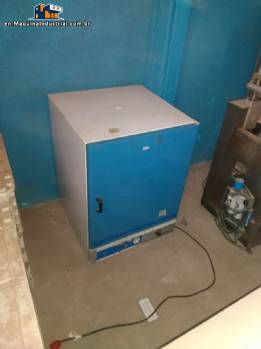
Static ovens operate in batches. They are closed stainless steel chambers where flasks and ampoules are pre-washed, placed in perforated metal trays or boxes, and introduced manually or by loading carts. After the door closes, the cycle performs the heating ramps, the sterilization plateau, and cooling through water or cold filtered air heat exchangers. This type is ideal for small batches, pilot plants, research and development laboratories, orphan drugs, or hospital handling.
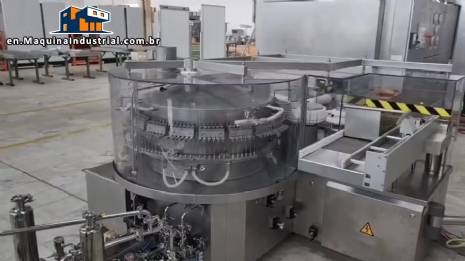
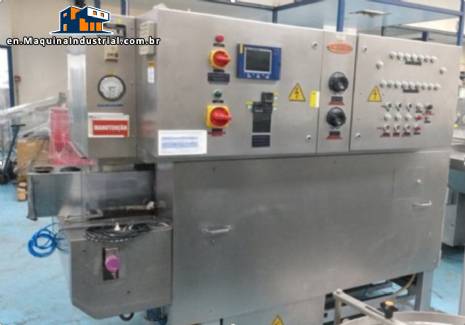
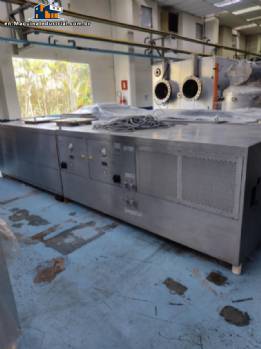
Continuous depyrogenation tunnels are high-performance equipment where glass containers enter continuously from an automatic washer and exit directly into the sterile zone of the filling and capping machine. They are internally divided into three main physical zones:
The first is the pre-heating zone, which receives the wet bottles from the washer. Laminar airflow removes residual surface moisture from the glass and gradually raises the temperature to avoid thermal shock.
The second is the hot sterilization and depyrogenation zone. This is the central area equipped with high-power shielded electric heating elements and special HEPA filters for high temperatures, operating between 300°C and 350°C. Here, the glass reaches the critical temperature for the destruction of endotoxins.
The third is the cooling zone. The hot glass needs to be cooled to approximately 20°C to 25°C before receiving the liquid or lyophilized medication, preventing the degradation of the active ingredient by the heat of the vial. This area uses laminar flow with air cooled by chilled water coils.
Feeding and Transport: The Behavior of Vials and Ampoules
Transport within the equipment varies according to the type of packaging handled.
In the processing of injectable vials and ampoules, the containers exit the washer pushed by mechanical guides and are deposited directly onto a conveyor belt of interwoven metal mesh, made of high-temperature resistant stainless steel alloys, such as AISI 314 or Nickel-Chromium alloys. The vials travel upright, touching each other in dense blocks. The conveyor belt speed is controlled by frequency inverters and synchronized with adjacent machines to prevent falls.
In ampoule processing, the scenario changes because they have pairs.
Thin vials, with narrow necks and light bases, are unstable and prone to tipping over. The system accommodates ampoules of types B, C, and D, ranging from 1 mL to 30 mL. In modern tunnels, ampoules can rotate lying down in cradles or transverse channels on the conveyor belt, or advance upright, restrained by ultra-tightened lateral guides and lateral compression systems that prevent chain tipping.
Sizes and Production Capacities
Equipment is sized based on the diameter of the vials or ampoules and the usable width of the conveyor belt or the internal volume of the chamber.
Small-scale models, aimed at pilot plants or low production, include greenhouses with an internal volume of 100 to 500 liters or tunnels with a conveyor belt width of 300 mm to 400 mm, generating a production of 2,000 to 6,000 vials per hour.
Medium-sized tunnels represent standard industrial production, using tunnels with conveyor widths of 600 mm to 800 mm, allowing for a production of 9,000 to 24,000 vials per hour.
Large-sized tunnels cater to high-volume global production lines, with tunnels having conveyor widths of 1,000 mm to 1,200 mm. Processing capacity reaches 30,000 to over 50,000 vials per hour, operating integrated with high-speed rotary fillers.
Industrial Applications
In the human pharmaceutical industry, which demands the highest level of regulatory compliance, the equipment is dedicated to lines for human vaccines, oncology drugs, high-potency biologics, antibiotics, anesthetics, and lyophilization solutions, where the vial exits the tunnel ready for filling and freezing.
In the veterinary industry, although regulatory principles are similar, there are practical particularities. There is a frequent demand for processing large-volume injectable vials, such as 100 mL, 250 mL, and 500 mL, for livestock use. Tunnels for this segment require extended cooling zones and reinforced conveyors to support the weight of the thick glass. They also serve poultry vaccine lines that demand high processing speeds due to the large volume of doses per batch.
Major Manufacturers and Global Brands
The market for used and semi-new industrial equipment with high reliability features major brands established internationally.
The IMA Group, from Italy, through its IMA Life division, which incorporated the former BOC Edwards Pharmaceutical Systems, is an absolute reference in high-speed tunnels and ovens integrated into complete filling lines.
Syntegon, from Germany, formerly Bosch Packaging Technology, has the famous HQL lines. Bosch HQL tunnels are considered the market standard in robustness and energy efficiency.
The Romaco Group, also from Germany, is heavily involved with the Romaco Macofar line, very common in medium-sized plants in Latin America.
PennTech and SP Scientific, from the United States, are well-known for their compact and efficient depyrogenation tunnels, focused on setup flexibility for different vials.
Steriline, from Italy, stands out as a pioneer in the integration of advanced robotics for feeding and the use of containment isolators integrated into the tunnels.
Bausch & Ströbel, from Germany, manufactures tunnels of very high technological standard and high cost, aimed at the largest multinational pharmaceutical companies in the world.
In the specific segment of high-performance static ovens, the Italian company Fedegari Autoclavi SpA is considered the world leader with its renowned FOD series.
Control Systems, Automation, and Regulatory Standards
The control of a modern tunnel or oven is fully automated and protected against data manipulation to meet international requirements.
The main parameters monitored in real time include the conveyor speed, which ensures the exact residence time of the glass in the hot zone; the temperature profile of each zone, controlled by multiple PT100 type sensors; the differential pressure between zones, essential to avoid cross-contamination by always directing air from the cleanest area to the least clean; and the integrity and speed of the laminar flow, measured by anemometers to ensure an ideal air velocity of approximately 0.45 meters per second.
In terms of regulatory standards, the sector is governed by Anvisa RDC 658/2022 in Brazil, which establishes the guidelines for Good Manufacturing Practices for Medicines. Internationally, systems must comply with the US FDA 21 CFR Part 11 standard for electronic records and audit trails, as well as follow the GAMP 5 guidelines for computerized system validation and the ISO 14644 standard for cleanroom classification. |