A capsule separator/polishing machine is a machine primarily used in the pharmaceutical, nutraceutical, and supplement industries.
The separator's function is to polish capsules to remove residual powder that sticks to the outside of the capsule after filling, leaving them clean, shiny, and with a better appearance. In addition, it separates defective capsules, such as empty, broken, crushed, or underweight capsules, from good capsules.
The capsules pass through rotating or spiral brushes. The powder is vacuumed by a vacuum system. Approved capsules proceed to packaging. Defective capsules are diverted for disposal.
These machines can be classified according to the separation method, construction type, and level of automation. Regarding the separation method, the most common is the weight and gravity separation system, in which filled capsules, being heavier, correctly follow the machine's flow, while empty capsules or those with low content are diverted for disposal. There are also models that utilize the rolling dynamics of the capsules, exploiting the different behavior between full and empty capsules, and, in industrial applications, more advanced systems that use electronic or optical sensors to identify defects.
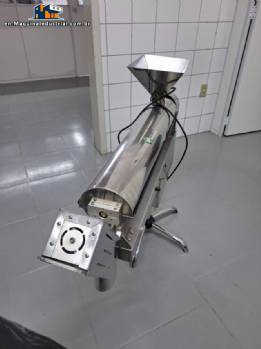
Regarding the construction method, tubular or helical polishers stand out, which use internal rotating brushes to promote polishing while the capsules move through an inclined tube.
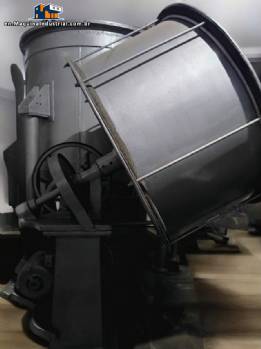
There are also rotary drum models, more common in larger-scale industrial environments, and systems based on vibratory conveyors, used in specific applications.
As for the level of automation, separating polishers can be manual, semi-automatic, or automatic. Manual ones require more operator intervention and are suitable for small-scale production. Semi-automatic ones automatically perform polishing and separation, requiring only manual feeding of the capsules, and are widely used in compounding pharmacies. Automatic ones are integrated directly into the encapsulator, operating in continuous flow, with high productivity and minimal human intervention, and are suitable for industrial lines. |