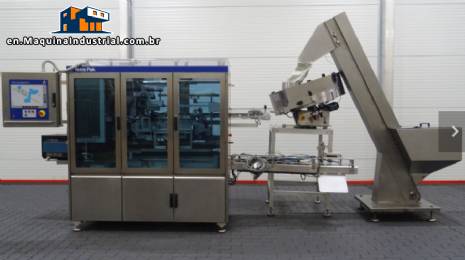
An automatic capping machine for carton packaging is an industrial machine installed on a filling line for liquid products in carton packaging, such as milk cartons, juice boxes, and plant-based beverage cartons.
Its function is to automatically feed, guide, position, and secure a plastic cap over the opening of the packaging. In many lines, the packaging leaves the filling machine already filled and sealed and then passes through the capping machine. Therefore, the equipment is classified as a post-filling or downstream machine.
Automatic capping machines can be classified into flexible models, high-speed models, and rotary models. Flexible models work with different packaging formats and volumes through adjustments and part changes. High-speed models are used in large production lines, usually configured for a specific packaging and cap combination. Rotary models use multiple heads to position and tighten the caps with torque control.
The main application systems are hot melt adhesive bonding, where the cap is positioned and fixed onto the packaging with a hot melt glue; Induction welding or thermal joining, which secures the opening assembly without the conventional use of glue; and mechanical threading, used when the neck is already installed and the machine simply places and tightens the cap.
These machines are used in the packaging of liquid foods and beverages in carton packaging, mainly serving the dairy, juice, plant-based beverage, and prepared food sectors.
In the dairy industry, they are used in products such as UHT and pasteurized milk, dairy drinks, flavored milks, chocolate milk, cream, and culinary creams. In the beverage segment, they serve lines of whole and concentrated juices, nectars, soft drinks, coconut water, ready-to-drink teas, functional beverages, and fruit-based products.
They are also applied in the production of soy, oat, almond, rice, and coconut beverages, as well as vegetable creams and mixes. In the liquid food industry, they can be used for packaging sauces, pulps, soups, broths, purees, creams, and culinary preparations, including those with small particles, provided the packaging and production line are compatible.
In addition to manufacturing industries, these applicators are also used by agro-industrial cooperatives and third-party packaging companies, known as copackers or co-manufacturers, which produce for other brands, retail chains, and private label lines. |