Used machines for sale
Main brands:
ECIL, Endress Hauser, Endress+Hauser, IFM, SMAR
|
| Temperature transmitters |
A temperature transmitter is a device that converts signals from temperature sensors (such as thermocouples or RTDs) into standardized electrical signals, usually 4-20 mA, 0-10 V, or digital protocols such as HART or Modbus.
Sensor → Detects temperature (resistance or voltage).
Transmitter → Converts the sensor signal into a reliable and standardized output for control or monitoring systems.
Basically, the transmitter allows temperature measurements to be accurately transmitted over long distances without signal loss or electrical interference.
Temperature transmitters are used for:
- Remote monitoring: Allows temperature values to be read on control panels or SCADA systems.
- Process control: In industrial systems, it maintains the temperature at desired levels using automatic controllers.
- Equipment protection: Detects overheating or hazardous conditions.
- Signal standardization: Converts signals from sensors, which can be fragile or sensitive, into robust signals for transmission.
- Compensation and linearization: Corrects sensor nonlinearities, ensuring accurate readings.
Applications of temperature transmitters:
Temperature transmitters are used in virtually all industrial and laboratory sectors where temperature control is critical:
- Food and beverage industry: Monitoring of thermal processes, pasteurization, fermentation, cooking.
- Chemical and petrochemical industry: Control of reactors, furnaces, pipelines, storage tanks.
- Pharmaceutical industry: Ensuring ideal conditions in reactors, incubators, and drug storage.
- Energy and utilities: Thermal power plants, boilers, turbines, steam lines.
- Building automation: HVAC (heating, ventilation, and air conditioning) systems to maintain stable ambient temperature.
- Laboratories: Tests, incubators, cryogenics, experiments with thermal control.
Types of sensors used with transmitters:
- Thermocouples (TC): Ideal for high temperatures, fast and robust.
- RTDs (Pt100, Pt1000): More precise, used in critical measurements, moderate temperature.
- Thermistors: Sensitive, used in electronics and HVAC.
The transmitter adjusts the output of these sensors to a standardized signal, allowing easy integration with controllers, PLCs, and SCADA systems.
Types of industries and processes that use temperature transmitters:
- Chemical and petrochemical: Chemical reactions, distillation, tank and process line control.
- Oil and gas: Pipelines, refineries, equipment monitoring and safety.
- Food and beverage: Pasteurization, cooking, fermentation, refrigeration.
- Pharmaceuticals and biotechnology: Reactors, incubators, processes requiring precise sterilization.
- Energy: Boilers, turbines, steam monitoring.
- Metallurgy: Furnaces, tempering, foundry.
Automotive and electronics: Component testing, painting and curing processes. |
|
|
|
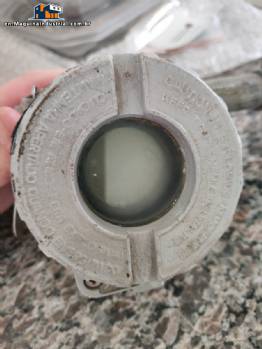 |
Brand: SMAR
Temperature transmitter for industrial instrumentation.
Manufacturer | Brand: SMAR.
Model: TT301.
Output signal: 4 - 20 mA.
Uᵢ = 30 V.
Iᵢ = 100 mA.
Pᵢ = 0.7 W.
Cᵢ = 6.7 nF.
Lᵢ = 0.
Ambient temp... |
|
|
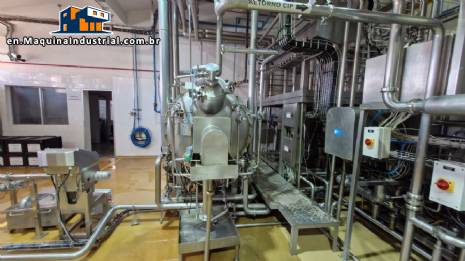 |
Brand: Alfa Laval, APV, Endress Hauser, Endress+Hauser, Kroma, NASH, Netzsch, Ricefer, SAMSON, SMAR, Spirax Sarco, Treu
|
|
|
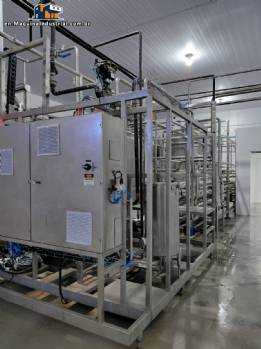 |
Brand: Alfa Laval, APV, APV SPX, Endress Hauser, Endress+Hauser, IFM, SPX
Industrial UHT ultra-high temperature pasteurization system with complete and overhauled tubular heat exchanger with retrofit.
Approximate capacity: up to 6,000 liters per hour.
For UHT thermal processing and ultra-high temperature pasteurizati... |
|
|
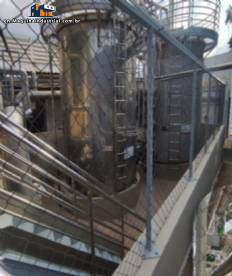 |
Brand: Alfa Laval, APV, Endress Hauser, Endress+Hauser, KHS, Spirax Sarco, Valmicro, Vortex
Automated CIP (Clean-in-Place) station for factories (such as food, chemical, and pharmaceutical) for internal cleaning of pipes, tanks, and equipment. Central station for large plants.
- CIP Station - Factory:
Composed of:
1 Jacketed tank f... |
|
|
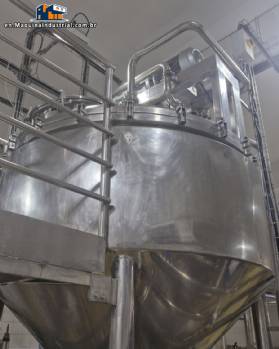 |
Brand: ECIL, Alfa Laval, Endress Hauser, Endress+Hauser, Nordix, SMAR
Jacketed stainless steel buffer/reactor tank with agitator/mixer.
Approximate capacity: 2,000 liters.
Year of manufacture: 2015.
Operating temperature: 120°C.
MAWP: 4 kgf/cm².
Model: Vertical cylindrical.
Top head: Flanged torispher... |
|
|
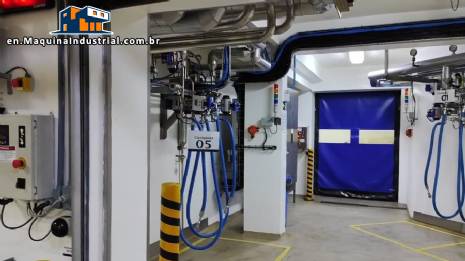 |
Brand: Endress Hauser, Endress+Hauser, Spirax Sarco
Container sterilization system.
Composed of:
– 30 Automatic stainless steel valves.
Manufacturer | Brand: Spirax Sarco.
– 6 Pressure transmitters and indicators.
Manufacturer | Brand: Endress + Hauser.
– 6 Temperature transmitters a... |
|
|
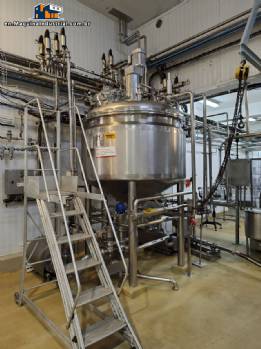 |
Brand: ECIL, Alfa Laval, Endress Hauser, Endress+Hauser, Inox Biaso, Nordix, SMAR
Jacketed stainless steel mixing/buffer reactor tank with agitation system.
Manufacturer/Brand: Inox Biaso.
Approximate capacity: 2,000 liters.
Material: AISI 304 Stainless Steel.
Operating temperature: 120°C.
MAWP: 4 kgf/cm².
Model:... |
|
|
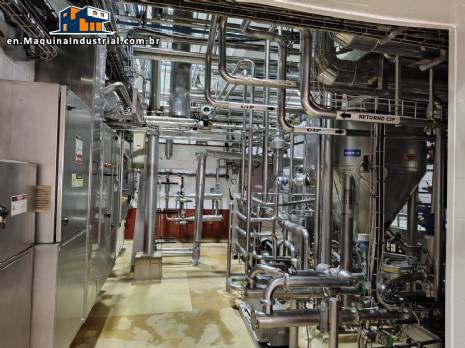 |
Brand: Alfa Laval, Endress Hauser, Endress+Hauser, SMAR, Tetralon, Valmicro
Reactor tank for processing food products, among others.
Composed of:
- 2 Mixing reactors with an approximate capacity of 1140 liters.
- 2 Reactor agitators, SEW manufacturer, with a 12.5 HP motor.
- 2 Tetralon lobe pumps, Tetralon manufa... |
|
|
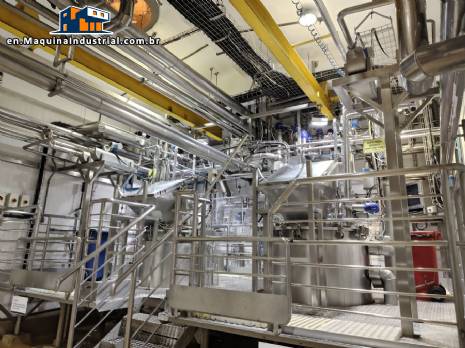 |
Brand: Alfa Laval, CIP, Endress Hauser, Endress+Hauser, Genova, Nordix, SAMSON, Spirax Sarco
Components: WEG
Production line system for various food products such as:
- Fruit preparations with or without pieces (pieces resistant to pumping);
- Toppings and sauces with or without pieces (pieces resistant to pumping);
- Injectable fillings for cakes ... |
|
|
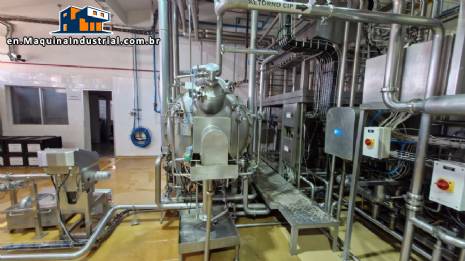 |
Brand: Alfa Laval, APV, Endress Hauser, Endress+Hauser, Loma Systems, NASH, SMAR
Automated system for preserving the integrity of products with chunks.
Set of industrial equipment for food processing, specifically designed to produce items with solid chunks that do not break down during the process.
Approximate capacity: 45... |
|
|
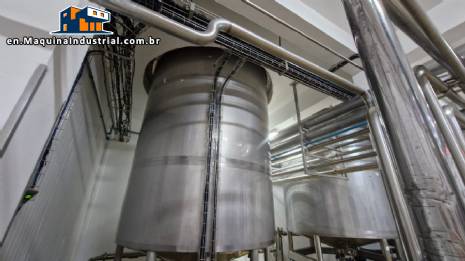 |
Brand: SMAR
Components: Alfa Instrumentos, Cestari, Smar, WEG
AISI 304 stainless steel tank with thermal insulation.
Approximate usable capacity: 12,000 liters.
The tank was used in a liquid (juice) line.
Year of manufacture: around 2010.
Operation: 5 years.
Idle time: 10 years.
Outside diamet... |
|
|
| |
| |
|